
Decision quality categories
FlopHero classifies every decision you make into four quality levels: Optimal, Strong, Weak, or Blunder. This helps you instantly understand how serious each mistake is and focus your study on the hands that impact your results most.
These categories are based on Delta EV (ΔEV) and EV Loss %, which measure how much expected value you lost compared to the GTO-optimal play. The thresholds are designed to emphasize real performance differences rather than small, insignificant deviations.
Decision quality categories give you a simple, actionable way to measure your play and prioritize your study. Fix the blunders, reduce the weak plays, and watch your win rate improve.

The four categories
Optimal
You made the solver-perfect play. ΔEV is zero, meaning there was no expected value loss. This is the gold standard - your decision matched what the GTO solver would do in this exact spot.
Don't expect every decision to be optimal. Even world-class players make strong decisions that are slightly off from perfect. The goal is to maximize optimal decisions in high-frequency spots and avoid blunders.
Strong
You made a decision that's only slightly off from GTO. ΔEV is very small and has little practical effect on your results. These are good decisions that won't hurt your win rate.
Strong decisions are fine. Don't waste time obsessing over tiny deviations. Focus on fixing weak plays and blunders first.
Weak
You made a clear strategic error that deviates noticeably from GTO. ΔEV is moderate and indicates a meaningful mistake. These decisions are costing you money and should be reviewed.
Weak plays often come from incomplete understanding of a spot. If you're making weak decisions in the same situation repeatedly, you need to study that scenario in the GTO Replayer to understand the correct strategy.
Blunder
You made a major error that lost a significant portion of expected value. ΔEV is high and the decision strongly hurt your EV. These are the mistakes that destroy your win rate.
Blunders are your top priority. Sort your Handlist by decision quality and review every blunder. These represent fundamental gaps in your strategy that need immediate attention.
These thresholds ensure that only meaningful mistakes get flagged. A 1% deviation in a $500 pot ($5 error) is categorized as Strong because it barely affects your results. The same 1% in a $20 pot ($0.20 error) is also Strong for the same reason.
Where you see decision quality
Decision quality categories appear in multiple places throughout FlopHero:
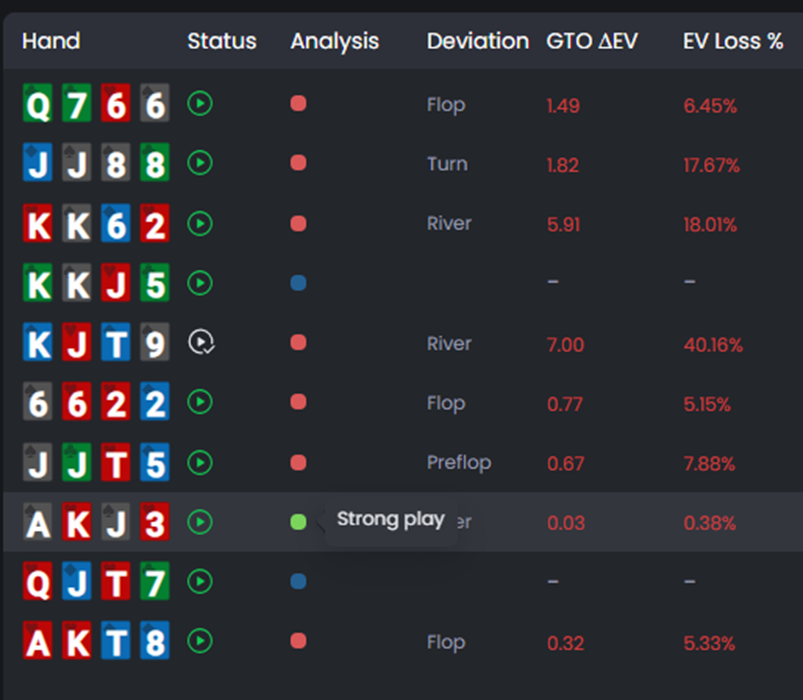
In the handlist
The Analysis column shows the decision quality for each hand. You can sort by this column to find all your blunders at once, making it easy to prioritize your study time.
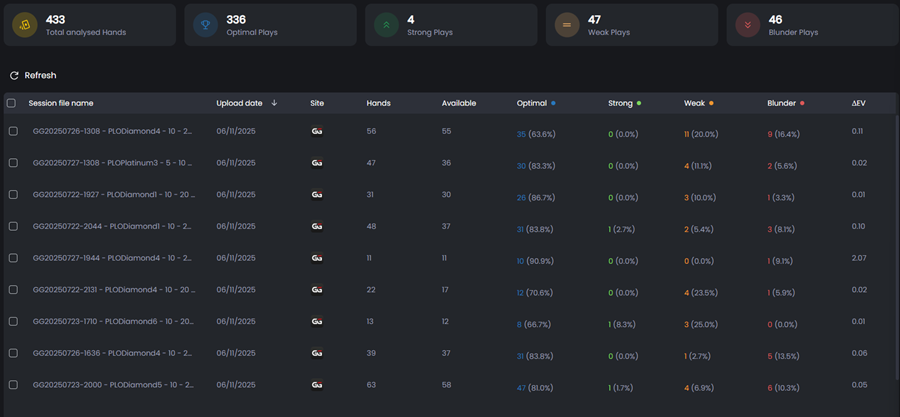
In the database page
The Database page shows a breakdown of decision quality across all your sessions. You can see what percentage of your decisions fall into each category, giving you a high-level view of your play quality over time.
Using decision quality to improve
Here's how to use decision quality categories in your study routine:
- Start with blunders. Sort your Handlist by decision quality and review every blunder. These are costing you the most money.
- Look for patterns. If you're making blunders in the same spot repeatedly, that's a fundamental gap in your strategy. Use Reports to filter for those situations and study them systematically.
- Fix weak plays next. Once you've eliminated blunders, work on reducing weak decisions. These are still costing you money, just not as much.
- Track your progress. Check your Session Dashboard regularly to see if your percentage of optimal and strong decisions is increasing. That's how you know you're improving.
- Don't obsess over strong plays. If you're making 90% optimal/strong decisions, you're playing well. Focus on eliminating the remaining weak plays and blunders.
Was this article helpful?
Still need help?
Join our community
Get instant support from experts and fellow players
Join Discord Community