
Understanding decision analysis
Inside the FlopHero Replayer, the Decision Analysis Panel reveals how a GTO solver approaches every spot in a hand.
Learning to interpret this panel is one of the fastest ways to upgrade your study process and decision-making at the table. Instead of guessing whether your play was correct, you get precise feedback on every decision.
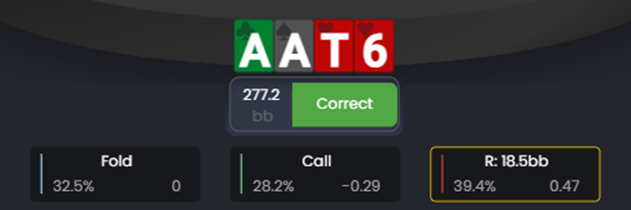
What GTO feedback shows
At each decision point, FlopHero displays the complete GTO strategy for that exact situation. Instead of a single "do this" answer, you see the solver's full range of actions, frequencies, and bet sizes that form a balanced strategy.
You get a complete view of:
- Every possible action and bet size
- How often GTO chooses each one
- The EV associated with every choice
This isn't just theoretical - it's the exact strategy a solver would use if it were playing your hand in your position with your stack depth on this specific board texture.
Making sense of the frequencies
Each possible action - check, bet 50%, bet 100%, raise, or fold - has a percentage beside it. This percentage shows how often GTO would take that action with the specific hand you're analyzing.
Example: with pocket tens on a certain board, GTO might bet 70% of the time and check 30%. Both actions are valid but appear in different proportions to keep your strategy balanced.
These are called mixed strategies - combinations of plays that prevent opponents from easily exploiting your tendencies. If you always bet with strong hands and always check with weak hands, observant opponents will crush you. Mixing keeps them guessing.
How your play stacks up
Your actual action appears highlighted in the panel so you can instantly compare it to solver logic. If your play aligns with one of the GTO options, it's marked as correct.
When you deviate, the panel shows the ΔEV - the exact amount of expected value lost by making a different choice. You can also switch to the EV Loss % to indicate how severe the mistake was relative to the pot size.
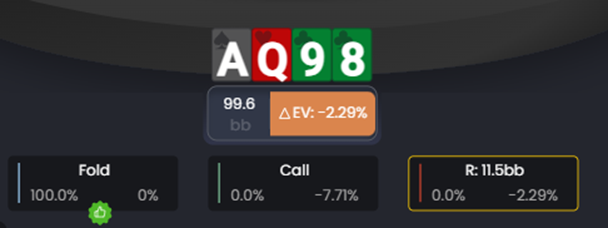
This direct comparison helps you see why a decision was suboptimal and what adjustment would have maximized EV. You're not just seeing "you made a mistake" - you're seeing exactly what you should have done instead and how much it cost you.
Getting your bet sizes right
The panel lists the bet sizes GTO uses for each situation. Many players underestimate how crucial correct sizing is - it affects range balance, fold equity, and pot geometry.
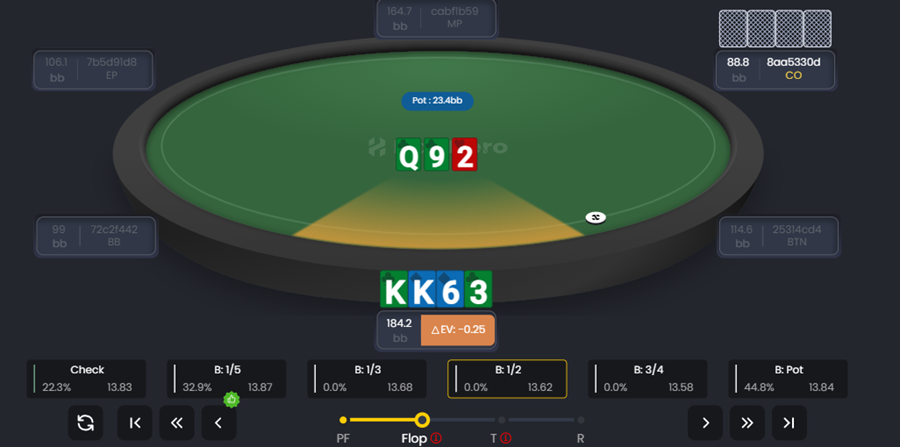
For example, you might see that GTO uses:
- 33% pot for thin value bets and bluffs
- 75% pot for polarized betting on dry boards
- 125% pot for overbet-or-check strategies on certain textures
Understanding why certain bet sizes exist for specific board textures helps you apply better sizing logic across similar spots. If you're consistently using 50% pot when GTO uses 75%, you're leaving EV on the table.
Why you shouldn't always pick the highest frequency
It's natural to want to copy the action with the largest percentage, but that misses the goal of GTO learning. GTO mixes actions for balance, not predictability.
The real skill is understanding why a mix exists and when to simplify it based on your game or opponents. You're not memorizing solver frequencies - you're internalizing strategic logic.
For example:
If GTO bets 70% and checks 30%, but your opponent never bluff-catches, you should bet 100%
If GTO raises 40% and calls 60%, but your opponent folds too much to aggression, you should raise more
The Decision Analysis Panel teaches you the baseline strategy. Exploitative adjustments come from understanding why that baseline exists.
Using decision analysis in your study routine
Here's how to get the most from the Decision Analysis Panel:
- Focus on high-ΔEV decisions first. Sort your Handlist by GTO ΔEV to find your most expensive mistakes.
- Ask why, not just what. Don't just see that GTO bets 75% - understand why that sizing makes sense for this board texture and stack depth.
- Check the Matrix View. See how your specific hand fits into the overall range strategy.
- Look for patterns. If you're consistently making the same type of mistake, use Reports to filter for that spot and study it systematically.
- Track your decision quality over time. Watch your percentage of Optimal and Strong decisions increase as you internalize GTO logic.
The Decision Analysis Panel turns every hand into a learning opportunity. Use it consistently and you'll see your understanding of GTO strategy deepen session after session.
Was this article helpful?
Still need help?
Join our community
Get instant support from experts and fellow players
Join Discord Community